Is Your Website Ready for AI Search?
A growing number of people don't type "plumber near me" into Google anymore. They ask ChatGPT, Gemini or Perplexity something like "Who's a reliable plumber in town that can come out this week?", and the assistant answers with a few names.
If an AI assistant can't read your website, it has a much harder time recommending you. And plenty of small business sites have problems here that the owner has never heard of.
How AI assistants learn about your business
Put simply, AI tools rely on automated crawlers that visit websites and try to make sense of what they find. Some of that feeds what the AI learns ahead of time, and some of it happens live, when the assistant looks something up to answer a question.
Either way, it comes down to two questions. Are the crawlers allowed in? And once they're in, can they understand what they're reading?
1. Are AI crawlers allowed in?
Every website can have a small file called robots.txt that tells automated visitors what they may & may not read. Some sites block AI crawlers there. Sometimes that's deliberate. Often it's an old template, a security setting or a copy-and-paste nobody remembers.
Our audit checks your robots.txt against the major AI crawlers, including OpenAI's search & ChatGPT crawlers, Google-Extended, PerplexityBot, Anthropic's ClaudeBot and Common Crawl's CCBot.
Blocking them is a legitimate choice for some businesses. But if you're a local business that wants to be recommended, it's usually working against you, and it's worth knowing either way.
2. Can they understand what they're reading?
Structured data. Schema markup is code that tells machines, in a standard format, exactly what your business is: your name, address, phone number, hours, services & more. Visitors never see it. Search engines & AI tools read it closely.
Page structure. Pages built with meaningful structure (a clear main content area, sections, navigation, headers & footers) are easier for AI to interpret than pages built entirely out of generic boxes.
Clear, real text. An AI can't recommend you for a service your website never actually mentions in words. If your services only appear inside images, or your pages say very little, there's not much for any crawler to work with. Plain descriptions of what you do, where you do it & who you do it for go a long way.
llms.txt. This is a newer, emerging convention: a plain text file at the root of your site that summarizes what your business does & points AI tools to your most important pages. Support for it varies between AI tools, so think of it as a low-cost extra rather than a must-have. Our audit checks whether you have one and whether it has enough in it to be useful.
3. The basics still count
Everything that helps Google helps AI tools too. A sitemap, pages that aren't accidentally hidden with a noindex tag, a secure HTTPS connection and fast load times all matter. A slow or broken page is as much of a problem for a crawler as it is for a person.
How to check your site
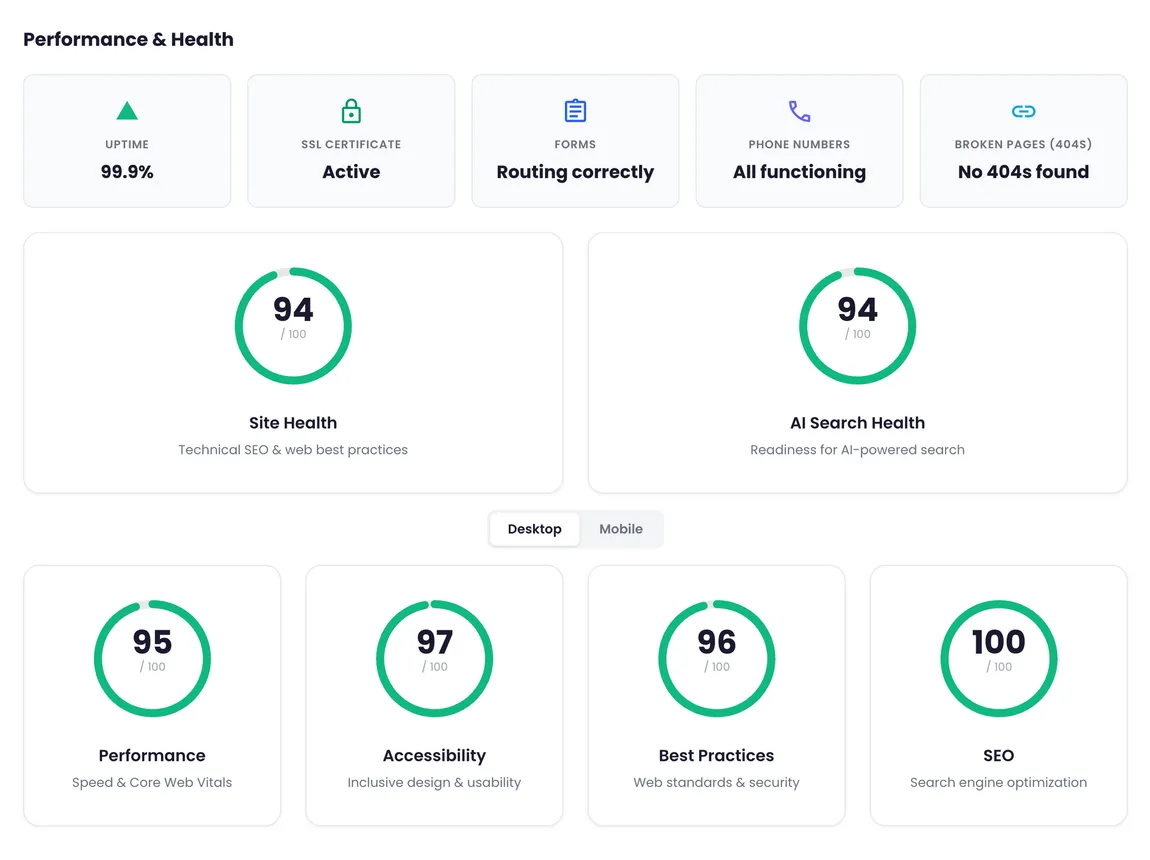
Our free website audit gives you an AI Search Health score alongside your Site Health & Performance scores. It checks AI crawler access, structured data, page structure & llms.txt, and tells you what to fix. No signup is needed. If you want to know what else the audit covers, read what a free website audit actually checks.
For Stacq clients, keeping an eye on this is part of the job. Stacq is a comprehensive online presence management platform for small businesses, and every client's monthly health report includes their AI search score alongside everything else, so you can see where you stand month to month.
Check your AI search readiness for free:
stacq.io/website-audit